

07 Feb Album Release: The Poet & The Prodigy
Les Délices’ next album drops on March 21, 2025. The Poet & The Prodigy. LD Founder, Artistic Director, and oboist Debra Nagy and longtime collaborator, harpsichordist Mark Edwards are featured in Couperin’s 1er Concert in G major from Concert Royaux and Bach’s Sonata in g minor, BWV1030b as well as ingenious new arrangements for oboe and harpsichord of Couperin’s 6me ordre for solo harpsichord and Bach’s Concerto in c minor. Below, read the album’s liner notes, written by Debra Nagy:
The Poet & The Prodigy Liner Notes
J.S. Bach’s chamber music, cantatas, and concertos have been a cornerstone of my repertoire since my earliest days studying music but I only encountered the music of François Couperin when I began to play the baroque oboe. As a result of those early experiences, I absolutely fell in love with the sensitivity and supple expressivity of French baroque music. Immersing myself in Couperin’s musical language, I gained an appreciation for its fluidity, creativity, structure, and highly-developed rhetoric. The music of Bach, meanwhile, became even more central to my developing career as a period-oboe specialist. Ultimately, Couperin and Bach have been constant companions, continually inspiring and challenging me these past twenty-five years. While Bach’s music – embodying his penchant for counterpoint, rigor, symbolism, and virtuosity – might seem at first to be diametrically opposed to more languid French baroque sensibilities, I find their juxtaposition deeply satisfying.
Despite an apocryphal story that François Couperin engaged in correspondence with Johann Sebastian Bach that ended up being recycled into jam pot lids, we’ll never really know if these great artists ever met. However, they cultivated numerous shared interests and their lives and careers followed similar trajectories for a time.
Connections between Bach and Couperin
Both men were revered organists and neither ever wrote or experimented with opera. Each also spent their early careers focused primarily on chamber music: Couperin was involved in Chamber music at Versailles and served as Ordinaire de la musique de la chambre du roi pour le clavecin from 1717. At the same time, Bach was serving the music-loving Prince Leopold in Cöthen. Most of Bach’s chamber music comes from this period (1717-1721), during which he was well-paid and held in high esteem.
Furthermore, both Bach and Couperin studied and incorporated Italian style into their works. For Couperin, the sonatas and trios of Arcangelo Corelli were a major influence whose effects can be heard in Couperin’s more virtuosic flourishes, his walking bass lines, and his burgeoning interest in imitative, abstract counterpoint. For Bach, copying, studying, and imitating concertos by Italian masters would deeply affect his output in both the secular and sacred realms. Bach had a prime opportunity to absorb the Italian style through music he bought from the Leipzig bookseller A. C. Sellius. Sellius was an agent for the famous Amsterdam printer Estienne Roger whose influential releases (including Vivaldi’s influential 1711 L’estro Armonico and the 1725 Il cimento dell’armonia e dell’inventione containing the “Four Seasons” concertos) enabled Italian trademarks like concerto ritornello form, driving rhythms, and unison orchestral writing to be heard and felt across the continent.
But it wasn’t just Italian style that Bach internalized – and here is where we can consider Bach’s potential connections to Couperin. Bach was clearly familiar with French keyboard composers and their style when he famously performed Louis Marchand’s harpsichord suites “ingeniously” and “from memory” in Dresden in 1717. In addition, Bach copied out Couperin’s own Les Bergeries in Anna Magdalena’s music book (given to her in early 1722) and had previously arranged the F major rondeau from Couperin’s trio sonata L’Imperiale for organ (BWV 587) around 1714.
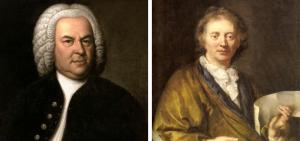
The two men were also deeply respected by their contemporaries and students. Couperin was considered “second to none” as a harpsichord and organ teacher while Bach was frequently compared with Orpheus, the master musician of myth. But while wide availability of Bach’s scores and frequent performance of his considerable output have ensured that his legacy was preserved, studied, and celebrated, Couperin – both the man and his music – remains relatively little known except to specialists. In truth, Couperin was a relatively private figure. Contemporary images of Couperin portray him as careful and forthright though his music offers glimpses of his dry humor and piercing wit. If we can dare to “know” Couperin by way of his music, we must admit his “quiet intensity” and eloquence above all.
So, given this disc’s title, can we determine who is the poet and who is the prodigy? Does it matter? Couperin and Bach were both extraordinary artists whose music gives us so much to contemplate and enjoy. In truth, the initial inspiration for this program was the idea of mutual admiration – not just of Bach for Couperin or vice versa – but also for me and harpsichordist Mark Edwards. Together, Mark and I wanted to create a program that enabled us to celebrate our collaboration in as direct a way as possible. As a result, we selected music that we absolutely love and ensured that the harpsichord serves as a true soloist and partner rather than as an accompanist. Furthermore, arrangement and flexible instrumentation were key practices for both Bach and Couperin so we have adopted those guiding principles in creating this program.
We begin with Bach’s astounding Sonata in g minor, BWV 1030b. This tour de force sonata for oboe and obbligato harpsichord is practically a world unto itself as it synthesizes concerto, trio-sonata, continuo sonata and fugal writing. The surviving copy of this piece dates from the late 1730s when Bach was in Leipzig and frequently adapted early works for use by the Collegium Musicum. The score records the piece in b minor with flute but several copying errors have led scholars to hypothesize it was based on an earlier version (perhaps with a different obbligato instrument) in g minor.
Couperin’s Premier Concert was composed around 1714 and was included in his 1722 collection of Concerts Royaux. Couperin himself supported flexible instrumentation for these pieces, explaining in the preface that these pieces were not only for the harpsichord, but could also be played on violin, flute, oboe, viol, and bassoon. Couperin went on to testify that he performed them this way in small concerts for Louis XIV every Sunday of the year. The Premier Concert in G major includes a beautiful prelude (complete with a Corellian walking bass line), a light and witty allemande, a pathos-laden Sarabande, a French cream puff of a gigue encrusted with ornaments, and a closing Menuet “en trio,” in which the harpsichord can play the second treble line with their right hand.

The Andante from Bach’s organ trio sonata in d minor, BWV 527 serves as a palate cleanser preceding selections from Couperin’s 6eme Ordre, which begins his Second book of pieces for the harpsichord. Pieces from these large suites can be performed individually or grouped together in different ways and we’ve chosen a particular arrangement of movements that enables us to alternate harpsichord solo in the characteristically French “style brisé” with movements the feature a distinct two-voice texture that recalls Couperin’s Concert Royaux. As was common for Couperin, evocative titles introduce each movement. Some name or identify individuals (like La Bersan) while others evoke a mood or sentiment (like the sighs of Les Langueurs Tendres or the busy buzzing of flies in Le Moucheron). The meaning of some titles may forever remain a mystery. Though Couperin’s pastoral confection Les Bergeries clearly imitates a shepherd’s droning bagpipes, we are left to speculate about the meaning of Les Baricades Mistérieuses (The Mysterious Barricades).
Original Arrangements
We close the disc with our own arrangement of the Double Concerto in C minor, BWV 1060. As with the sonata that opened our program, this concerto survives in an arrangement from the late 1730s for two harpsichords with strings. Scholars believe that the two harpsichord version was likely a reworking of a concerto for oboe and violin from Bach’s Cöthen years. Mark proposed splitting the difference between these two versions to create another opportunity for us to perform as a duo of oboe with harpsichord obbligato. We find the results extremely enjoyable – and we hope you do too!
– Debra Nagy