

05 Sep Blog: O’er the Hills and Far Away
Read the program notes!
O’er the hills is all about music and migration: imagining the sounds and strains echoing initially across the Atlantic and then across the hills and valleys as young men left the old world for the new, went to war fighting for freedom, and ventured west in search of independence and opportunity. Along the way, we offer both famous and little-known tunes that not only lift our spirits but also give us plenty to think about.
Most of the tunes on the first half of our program were well-known on both sides of the Atlantic for generations: early-eighteenth Scottish century ballads like Tweedside, Lochaber, and Roslyn Castle were frequently heard during the Revolutionary War and were still being printed and cited in American-published tune books, fife manuals, and songsters well into the nineteenth century. For instance, Farewell to Lochaber originally appeared in Allan Ramsay’s 1724 Tea-table Miscellany but was still popular enough to be included in the 1829 edition of Philadelphia publisher Grigg’s Southern and Western Songster. As slow our ship – with its text about leaving home and nostalgia – is also found in Grigg’s 1829 Songster borrowing a popular air known as “The Girl I left behind me” which was also a British military march dating to the 1750s called “Brighton Camp.” Likewise, Roslyn Castle was first published by Scots fiddler William McGibbon under the title “The House of Glamis” but was used by both British and Continental troops to honor fallen soldiers, which earned it the moniker “Dead March” during the Revolutionary War as well as during the War of 1812.

American Art Song
Songs by Francis Hopkinson (a friend and colleague of George Washington and Thomas Jefferson) and William Billings, and early-nineteenth century ballads like The Lovely Ohio and Logan’s Lament on the other hand, attest to early American optimism and hubris.
With a text by Irish clergyman Thomas Parnell, Hopkinson’s My days have been so wond’rous free (1759) is often cited as one of America’s earliest secular art songs. Hopkinson never considered himself a professional musician however: he was trained as a lawyer and had the honor of being one of the original signers of the Declaration of Independence. Nevertheless, he published a set of eight songs in 1788 that he dedicated to his longtime friend George Washington, claiming, “I cannot, I believe, be refused the credit of being the first native of the United States who has produced a musical composition.” He continued, “If this attempt should not be too severely treated, others may be encouraged to venture on a path, yet untrodden in America, and the arts in succession will take root and flourish amongst us.”
Popular Tunes and Military Marches
The fluid functionality between popular tunes and military marches means that both genres sat side by side in published music books for fife and drum corps and other military bands. In fact, I’ve drawn many of the instrumental tunes on this program from James Aird’s 1782 five-volume Selection of Scotch, English, Irish, and Foreign Airs Adapted to the Fife, violin, or German Flute. In Aird’s Selection, old Scots tunes like Tweedside, 1770s nursery rhymes like O dear, what can the matter be, and Irish reels Linky Lanky and Pady Whack (sic) sit alongside military marches. Aird also offers the earliest published version of signature American tunes like Yankee Doodle (with variations!) and George Washington’s March as well as France’s Marseillaise and a gigue with the title L’Ord’nance. America’s early republic owed significant debts to their French allies, particularly to military officers like the Marquis de Lafayette who volunteered to join the Continental Army. Lafayette was celebrated as a national hero upon a return visit to the U.S. in 1824, as the tribute in song – an adaptation to Robert Burns’ “Auld lang syne” (found in Grigg’s 1829 Songster) – makes clear.
After the Revolution
Following the Revolution and 1783 Treaty of Paris, speculators and settlers were eager to claim new land (and potential profits) in the unorganized territories north of the Ohio River and west of the Appalachians. Native Americans from Delaware, Iroquois, Erie, Shawnee, Wyandot, Miami and other tribes had already endured decades of conflicts and broken promises with French and English traders and military before various settler groups began claiming land in the greater Ohio River valley. Germans and Moravians from Bethlehem, Pennsylvania had been granted 12,000 acres in 1772 “for the work of Christianizing Native people” along the Tuscarawas River & in Lorain & Stark Counties; Virginians migrated to land between the Scioto and Little Miami Rivers – bounties that had been promised to them as Continental troops; Yankees settled along the Ohio & Muskingum Rivers following the formation of the Ohio Company at Boston in 1787; and settlers from Connecticut carved up land abutting Lake Erie’s northeast corner, known as the Western Reserve.
Western Expansion
Heading west and homesteading, of course, could be hard and isolating, as Hopkinson’s The Traveler benighted (1788) attests. Yet, as a promised land that had previously been off limits, Ohio was practically a mythical Eden. As the early nineteenth century ballad The Lovely Ohio relates, the valley held the promise of plentiful natural resources (including fish, game, and arable land) and an independent lifestyle for new American families.
Land grabbing and new settlements were not good for everyone, however. Logan’s Lament commemorates the Yellow Creek Massacre of 1774 in which Virginia settlers brutally killed at least a dozen Mingo Indians on the upper Ohio River, spurring a conflict known as Lord Dunmore’s War. James Logan, a Mingo leader who had previously maintained friendly relations with white settlers but who lost multiple family members in the massacre (and had the right to retaliate for their murders), refused to attend treaty negotiations following the conflict but wrote a speech that became known as “Logan’s Lament.” His speech was published widely, including in Thomas Jefferson’s 1787 book Notes on the State of Virginia. Poetic elaborations of Logan’s Lament survive from at least the early 1840s; the ballad we perform dates back to the mid-nineteenth century and was collected in the 1930s by historian and folklorist Mary O. Eddy in Ballads and Songs from Ohio. You can learn more about Logan (1723-1780), a member of the Cayuga nation, via the Native Heritage Project here: https://nativeheritageproject.com/2014/01/26/logans-lament/
Public Works: The Ohio and Erie Canals
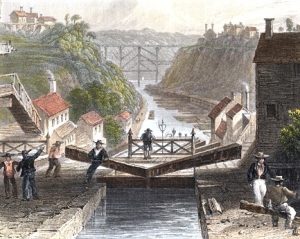 The major public works projects of the Ohio and Erie Canals – which opened 200 years ago in 1825 – enabled westward migration, settlement, and commerce on a scale that was not previously possible. The Meeting of the Waters celebrates the canals’ triumph of engineering (or art) over nature on a grand scale. The canals enabled goods (whether lumber, coal, flour, imported furniture, and much more) and people (not only tourists but also enslaved people) to pass from the east and the south to points west and north including the Great Lakes and Canada. Despite their relatively slow pace, boats drawn by horses or mules walking the towpath alongside the canal were infinitely faster, less expensive, and more reliable than transportation by carriage through challenging or undeveloped landscapes. Of course, the building, expansion, and maintenance of the canal system would not have been possible without the back-braking labor of immigrants (particularly the Irish) and claims of eminent domain meant that landowners’ properties were frequently cleaved in two by public works. We get a sense of the canal’s playfully slow pace in the 1842 ballad I’m afloat. In addition, as we hear in The Old Skipper, operating canal boats was a relatively good job compared with the danger, discomfort, and duration of commercial ocean sailing.
We close our program with the traditional song O’er the hills and far away, which encapsulates the themes and chronology of today’s program. The tune dates back to 1690s Scotland, appearing in numerous music manuscripts and publications throughout the eighteenth century. It also traveled to colonial America, appearing in musician’s copybooks through the Revolutionary Era and well into the nineteenth century. Its text conjures nostalgia and longing – or rather, loathing to depart – and it did triple duty as a ballad, country dance tune, and a military march.
– Debra Nagy