

02 Jan Program Notes: A Red, Red Rose
Les Délices is thrilled to announce a new program inspired by the music and poetry of the Scottish Highlands. Tenor James Reese joins the ensemble for A Red, Red Rose. Upcoming performances include a special concert at Hofbräuhaus Cleveland on January 15th (limited tickets remain), two concerts January 16th and 17th in Michigan presented by the Academy of Early Music, and a free concert on January 18th at the Hudson Library & Historical Society (registration encouraged.)
Notes on the Program by Artistic Director Debra Nagy:
 From the moment of their first publication in 1786 by a small provincial press in Kilmarnock, Robert Burns’s poetry was a sensation. Readers from every level of society appreciated the immediacy, realness, unpretentiousness, insightfulness, perceptivity, and deep emotions inherent in his work. In his poetry, he could identify with the plight of a mouse who is unexpectedly evicted from the security of his home, lean into sentimentality, evoke a visceral sense of place, or voice egalitarian and libertarian viewpoints with urgency. The sentiments of the “ploughman poet” continue to resonate across time and space and have by no means been limited to folks of Scottish descent.
There’s also something near-impossible or “against the odds” about his accomplishments. Born to a tenant farmer who accrued considerable debts, Robert had little formal education. When not working the heavy clay soils of Ayrshire that yielded miserable harvests, however, he absorbed virtually every piece of literature he could get his hands on. Committed to learning, he and his brother Gilbert even founded a debating society dubbed “The Bachelors’ Club” for the “intellectual improvement” of himself and his peers.
While Burns’s “everyman” ethos meant that people saw themselves in him and in his works…they also saw whatever they wanted in the man himself. As a result, he acquired a posthumous reputation not only as a great poet but also as a drunk and a rake. But as Burns biographer James McKay points out, “the man who ran a 170-acre farm, rode two hundred miles a week on Excise duties and kept four sets of Excise records, and still found time to compose…besides conducting a voluminous correspondence era writing songs for two publishers simultaneously, was a workaholic, not an alcoholic.”
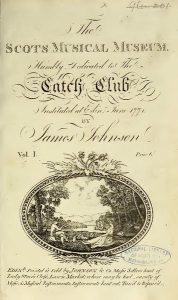 In this program, we’ll hear some of Burns’s most beloved poetic and lyric works – often in musical settings that he personally recommended or oversaw. While Burns was reportedly tone-deaf (apparently he absolutely could not hold pitch), he did major work collecting and revising tunes and lyrics as a primary contributor to the six-volume Scots Musical Museum (published by James Johnson between 1787-1803). Contributing over 350 items, Burns drew on a vast store of Scots songs that he both knew already and collected on journeys through the countryside – not so unlike ethnomusicologists making field recordings to preserve traditional music. Burns also used fragments of existing lyrics as the basis for his own poems and he chose existing tunes on which to compose new lyrics.
For instance, Burns claimed that one of his most famous love songs, A red, red rose, was a ‘simple old Scots song which I had picked up in the country’. Though A red, red rose is best known today set to the tune “Low down in the broom,” Burns himself indicated that ‘The tune of this song is in [violinist] Niel Gow’s first Collection and is called there, “Major Graham,” which is the tune that we present in this performance.
Similarly, the universally famous Auld Lang syne is a “collected” lyric rather than composed one. The final two stanzas were added by Burns; the tune was a well-known strathspey “The Miller’s Wedding” Singing the song on Hogmanay or New Years Eve quickly became an annual tradition and Auld Lang syne also became the traditional close to annual Burns Night suppers (celebrating the poet’s birthday on January 25th). The tune of Auld lang syne also bears a strong resemblance to that of Comin thro’ the rye.
Some of Burns’s most sentimental lyrics refer directly to his early love affairs and relationships with particular individuals. Ae fond kiss (to the tune of “Rory Dall’s Port”) was addressed not to a lover but a beloved friend, Agnes McLehose of Edinburgh who was known as Nancy to her friends. Highland Mary, on the other hand, has been identified as Margaret Campbell, with whom Burns had an intense but short-lived affair comprising perhaps four weeks in late spring 1786. Margaret died tragically of typhus at age 23 and Burns felt deep remorse as he lived with her memory for years. He could not reveal her true name but referred to her in several songs including,“Highland Mary,” which Burns composed in November 1792 to the famous old tune “Katherine Ogie.” Green Grow the Rashes O is more of a general celebration of “the lasses,” that Burns assigned to “the merry old tune of that name.” For this performance, we’ve brought together settings from violinist William MacGibbon’s first book of Scots Tunes (1742), the Scots Musical Museum, and a reel from Neil Gow’s Complete Repository of Dance Music of Scotland (1805).

Queen Anne being presented with the Act of Union of 1707
As we’ve seen, Burns never shied from debate or his convictions. Poems like A parcel of rogues typified Burns’s support of Scottish nationalism as it decried those members of the Parliament of Scotland who signed the Act of Union with England in 1707. The tune was published in 1747 in James Oswald’s Caledonian Pocket Companion under the title “A parcel of Rogues in the Nation;” Burns’s words and music were included in volume 4 of the Scots Musical Museum (1792). Burns also publicly expressed support for the French and American Revolutions, although his poem A Man’s a man for a’ that had to be published anonymously in the August 1795 edition of the radical monthly Glasgow Magazine. Espousing ideas about liberty, equality and universal human rights, it was supposedly influenced by Thomas Paine’s The Rights of Man, which had recently been issued in England.
Burns’s knowledge of the repertoire of Scots melodies and dance tunes must have been enormous. The instrumental selections on our program draw from the contemporary sources he knew and referred his editors James Johnson and George Thomson to. In particular, music by James Oswald (1710-1769) figures strongly in our program on account of his numerous and wide-ranging collections of Scots tunes (including 12 volumes of the Caledonian Pocket Companion). Besides composing new fiddle tunes and variation sets on older, traditional melodies, Oswald also composed in galant, Italianate genres that are exemplified by his ambitious set of 96 sonatas known as Airs for the Seasons, each of which was named for a different flower or shrub.
– Debra Nagy