

27 Jan Notes on the Program: A Moment’s Oblivion
Debra Nagy on A Moment’s Oblivion
 Today’s program reflects an emotional journey that represents what it is to be human. The inherent joy and beauty of life contrasts with disappointments and the unexpected takes the form of opportunities as well as challenges. While we must live with the results of difficult decisions and the resolutions we arrive at may not be what we first anticipated or hoped for, the journey offers the possibility to transcend our circumstances and creates ample opportunity for introspection.
Our program alternates instrumental works with secular cantatas – a special genre of Baroque chamber music that uses mythology to explore ideas around fidelity, fate, death, and more. I’ve long felt that cantata’s unique combination of music & myth has real power to excite our imaginations, build empathy, and relay universal wisdom that is both relevant and resonant today. These brief dramatic works (usually 10-15 minutes) are like mini-operas in which one singer and a small chamber ensemble can embody many different characters. Interestingly, while mythology usually tries to make sense of the world around us through supernatural means, the cantatas featured in this program contain no dragons, ghosts, or gods who sweep in and save the day.
Instead, each of the cantatas in our program questions what it takes to find happiness in the face of challenges or injustice. Their central messages are about change and acceptance: acknowledging that change has to happen and that sometimes there may be a silver lining. Ultimately, A Moment’s Oblivion promises to be a thought-provoking and beautiful concert experience that meditates on emotional journeys while offering opportunities to contemplate universal themes of community, love, and healing.
Music by François Couperin
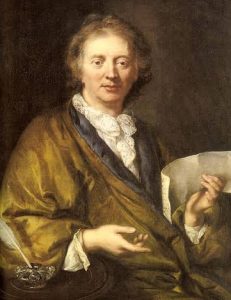 We begin with an introspective trio sonata by François Couperin. Dating from an experimental period in the late 1690s and never published, this sonata carries the suggestive title La Visionnaire – the visionary. Who or what is this visionary? Someone who sees multiple points of view? A view to another world? A healer? Following a slow, searching opening, Couperin’s sonata consists of many short sections in the tradition of Arcangelo Corelli. At the sonata’s emotional center are two heartfelt arias or soliloquies. La Visionnaire ends brilliantly with a fugue that borrows elements of a ground bass: a descending, lament-style subject is presented first by the viola da gamba and harpsichord and then taken up by the violin; meanwhile contrasting countermelodies make hopeful, rushed ascents that brim with excitement and confidence.
Two cantatas by Montéclair
The first of three cantatas, Michel-Pignolet de Montéclair’s La Bergère centers on a rejected shepherdess who reasons that letting go of anger and embracing beauty in the present will enable her to find rest and, ultimately, peace. By contrast, the jilted protagonist of Le Dépit généreux (Generous Spite) is far more reactionary – she initially seeks revenge to combat her shame and misplaced feelings of guilt. Montéclair’s musical setting mirrors the text’s psychological turmoil as impetuous flashes of anger in the violin and viola da gamba melt away to reveal a tearful, chromatic descending bass line that accompanies a series of rhetorical questions: “Mais pourquoi soupirer? Pourquoi verser des larmes? (But why sigh? Why shed tears?). The second recitative that begins “Cherirai-je toujours une fatale flame?” (Will I forever cherish a fatal flame?) similarly alternates introspection with personal resolve. In the end, the protagonist finds sweet release by practicing what might be freely interpreted as “non-attachment”: Sweet tranquility, peaceable indifference, and a favorable calm take the place of shame and disappointment to reign victorious in her heart.
Marin Marais’ La Labyrinthe
Marin Marais’ amazing character piece La Labyrinthe (The Labyrinth) takes both players and listeners on another transformational journey. This solo for viola da gamba and basso continuo is unique in scope (only Marais’ chamber work La Gamme is longer or more ambitious) as well as form. It’s not a mere “character” piece, a traditional rondeau, or even a sonata; some parts seem to “speak” like recitative while others resemble fantasia. While its initial jaunty “walking” music returns several times over the course of the twelve-minute piece, contrasting sections modulate frequently and wildly far from the home-key of A major. Some of these departures descend into confusion or disorientation: they might represent places where one encounters darkness, fear, shadows, or isolation. And yet, just like in a labyrinth, one can turn a corner and find oneself suddenly and (perhaps) unexpectedly back in the light. The reward for having made our way through the labyrinth’s trials and tribulations is the beautiful, courtly chaconne that ends Marais’ masterpiece – one can almost feel the player emerging from the maze’s dark confines to be welcomed into a world of light and order.
A World Premiere from Viet Cuong
 At the heart of our program is a new cantata composed by Vietnamese-American composer Viet Cuong, A Moment’s oblivion. The story comes from a traditional Chinese myth called “The Loss of Memory Myth.” In it, a middle-aged man loses his memory and is later miraculously cured. However he comes to resent his family for “healing” him because he now has to remember “the ten thousand vexations of my decades of life.” He wonders “where shall I find another moment’s oblivion?” To shape lyrics from the prose myth I tapped acclaimed Cleveland-Heights based poet Dave Lucas who crafted a beautiful text about remembering, forgetting, healing, family, and fate that uplifts the original myth’s language to reveal its universal messages.