19 Mar The Mermaid: Notes on the Program
The Mermaid
April 25-27, 2025, Les Délices presents The Mermaid, a fantastic new program featuring folk music powerhouse Seán Dagher, beloved soprano Elena Mullins Bailey, and an ensemble of oboe, recorder, violin, cello, and percussion. Together, they’ll weave a magical story of a sailor who leaves home in search of adventure… complete with fiddle tunes, heart-wrenching ballads, rustic sea shanties, refined art songs, and so much more! Tickets for all three performances (Akron, Cleveland Heights, Rocky River) are on sale now. Click here to purchase. Read on to learn more about this special program!
Notes on the Program
Mermaids have fascinated us all at one time or another. Even before the two-tailed medieval mermaid Melusina was commandeered to serve as Starbucks’ logo, visions of mermaids have inhabited our days, our dreams, and perhaps also our nightmares. In the Age of Exploration, the half-human/half-fish mermaid represented the fantastic, the limits of what mankind could know or understand, and embodied the wondrous creatures one might find at the edges of the world. Over 100 years later, the scientists and philosophers in the Age of Reason were not yet ready to dismiss the existence of mermaids, seeking instead to understand and explain their existence through the lens of cutting-edge evolutionary science.
The Mermaid throughout history
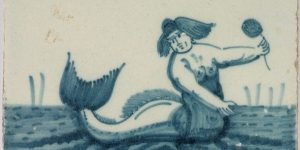
With beautiful, long flowing hair, a voluptuous torso, and frequently depicted holding a mirror and a comb, mermaids are objects of desire that man cannot reasonably possess: to succumb to temptation and follow one into the green water means drowning. Assuming the guise of a damsel in distress, mermaids are often depicted on a rock, which similarly presents a clear and present danger for any sailor: in a storm, being near the rocks means your boat could be smashed against them.
In our program, images – and echoes – of the mermaid appear and reappear. We begin our voyage with a scene at the docks where our boatswain and his beloved bid their final farewells. To you who live at home at ease (also known as The Faithful Mariner) does double duty explaining to “landlubbers” the inherent dangers of ocean voyages (from weather, to pirates, and armed warfare) while gesturing to loved ones left at home (“I’ll be inspired by Molly’s charms, with whom I leave my heart”). For her part, we hear a well-known 18th century Scottish ballad, The Boatman (also known as The Bonny Scot).
The timeless fun of sea shanties
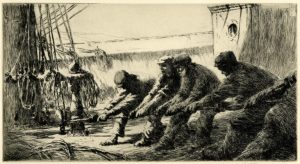
From there, the ship’s crew labors by day with sea shanties like Randy dandy O and Haul on the Bowline that set “the tempo of teamwork” and they tell stories of giants (Stormalong), pirates (Captain Ward and the Rainbow), and bad-omen encounters (The Mermaid) by night. Along the way, their dreams are haunted by the sweet voices of the lasses they left behind.
Following a dangerous night of storms and visions of mermaids, our crew awakens to clear skies and is ready for their return trip. Goodbye, Fare ye well was a popular “homeward-bound” shanty sung at the capstan while raising anchor. Leave her Johnny is a capstan shanty that was “traditionally the last song sung before docking.” It offered the crew a chance to air their grievances about the poor conditions aboard ship.
With our boatswain back on shore, our lovers are reunited. In Maurice Greene’s Fair Sally, the lass welcomes home her “Constant Thomas” who, “tho’ out of sight,” was “n’er out of mind.” The night comes to an end with Good Night and Joy be wi’ ye a’. As the final tune in Book 2 of bandleader Neil Gow’s Repository of the Dance Music of Scotland (1802), Gow reminds us that this tune was “played at the conclusion of every convivial dancing meeting throughout Scotland.” First published in Henry Playford “A Collection of Original Scotch-Tunes” (1700), our performance includes variations drawn from James Oswald’s “Caledonian Pocket Companion” (1760).
The Golden Age of Sail
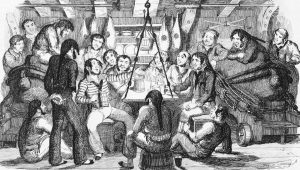
Virtually all the music on this program can be traced to the golden age of sail, which coincides with what scholars refer to as “the long 18th century,” roughly 1650-1840. Besides the call-and-response sea shanties intended to unify the crew in hoisting sails or raising anchor, we’ll hear ballad tunes (known as forebitters) that were sung and enjoyed for entertainment, and country dance tunes that echo bygone fiddlers. Other sturdy, portable, or improvised instruments – like recorder, flute and pipe; guitar (or here, Irish bouzouki), bass, and improvised percussion complement our little band evoking music sung and heard at sea.