

04 Feb Notes on the Program: Marianne Mozart
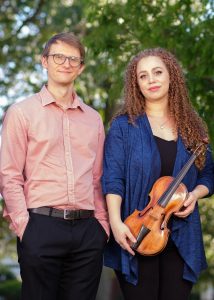 Les Délices core members Shelby Yamin (violinist) and Mark Edwards (fortepiano) will present familiar works of Wolfgang alongside brilliant, often overlooked compositions by his female contemporaries in a special recital presented by The Cleveland Museum of Art inside Gartner Auditorium on March 22nd, 2026 at 3:00 pm. Tickets for Marianne Mozart at the Cleveland Museum of Art are available now via the CMA website.
Notes on the Program: Marianne Mozart at CMA
Marianne Mozart, known as Nannerl, was an acclaimed keyboardist and composer who toured Europe alongside her younger brother, Mozart. She was a masterful keyboard player in her own right, touring and performing throughout Europe until age 17. Her father Leopold wrote in 1764, “My little girl plays the most difficult works which we have… with incredible precision and so excellently. What it all amounts to is that although she is only 12 years old, is one of the most skillful players in Europe.”
Beyond her surviving letters and descriptions of her performances, however, traces of her artistic voice are limited. We don’t have any surviving compositions by her although Wolfgang wrote to her in 1770, “I am amazed! I had no idea you were capable of composing in such a gracious way. In a word, your Lied is beautiful. I beg you, try to do these things more often.”
It’s tempting to imagine what *might have been* had circumstances enabled her to fully pursue a career in music. This afternoon’s program seeks to create context for Marianne Mozart’s legacy as we consider other female composer-performers’ artistic outlets and professional accomplishments.
Our program begins with a work by 10-year old Wolfgang Amadeus composed in Holland at a time when the siblings’ personal and professional lives were most intertwined. Just a year earlier, Carmontelle painted a famous “calling card” family portrait that showed young Wolfgang at the keyboard, his father Leopold playing the violin over his shoulder, and Marianne singing. The artistic composition is a bit of a fabrication: Marianne never established a reputation as a singer and it could just have easily been Marianne playing the accompanied keyboard Sonata in Bb KV31 that Wolfgang would publish in 1764 (as the family neared the end of their first grand European tour) with her younger brother on the violin.
The accompanied keyboard sonata was a short-lived but popular genre designed for players in domestic settings: it enabled flexibility in performance (oftentimes, the keyboard part would still be “complete” without the accompaniment) and it ensured that musical partners with varied ability or experience could enjoy each other’s company. The violin or other instruments primarily played a supporting role adding musical commentary, providing harmony,or otherwise adding to the texture but not necessarily presenting new ideas or melodic material. Mozart’s K31 sonata in Bb adopts the popular two movement form including a tuneful allegro followed by playful a Minuet-based theme and variations.
As scholar Eva Neumayer has noted, “For a musician’s daughter in the eighteenth century, there were few alternatives to marriage as a means of support. Since she was very well educated, Maria Anna Mozart’s best choice would have been a position as a governess in an aristocratic family.” Marianne might have had other possibilities if she had been an accomplished singer. However, since Marianne was “a pianist, taking a post as a singer at the Salzburg court was not possible, even if an opening had been available. Other posts were out of the question for women.”
By contrast, Wolfgang’s exact contemporary Franziska Lebrun (1756-1791) established herself as a celebrated German soprano whose brilliant but short career extended across the continent. Like Marianne, Franziska was born into a musical family with court connections. Her father Innocenz was an Italian-born cellist in Mannheim (home to one of the greatest orchestras in all of Europe) and both of her brothers went on to establish reputations as composers. Franziska married another court musician, oboe soloist Ludwig August Lebrun and together they regularly appeared at Paris’s Concert Spirituel and were celebrated in London as well. Franziska was a truly astounding singer with an extraordinary high range. She literally opened the opera house La Scala in Milan as the prima donna in Salieri’s Europa riconosciuta and her performing career overlapped with Wolfgang’s on 13 March 1785 when she performed at an academy he organized at the Burgtheater in Vienna.
It was during Franziska’s London sojourn that she published her Op. 1 and Op. 2 sonatas for fortepiano with violin accompaniment. We’ll hear her Sonata no. 4 in C major from the Op. 2 collection, which includes a singing first movement Allegro and a boisterous Rondo.
As we’ve seen, women could perform at the piano or make careers as singers…but rarely as violinists. Maddalena Lombardini Sirmen (1745-1818) was an exception. Born to minor nobility, Maddalena was educated at San Lazzaro dei Mendicanti, one of Venice’s famed Ospedale where young women of varied backgrounds received excellent educations, particularly in music.
Although Marianne Mozart stopped traveling at age seventeen, she hardly stopped making music prior to getting married at age 33. Rather, she seems to have been fully engaged with teaching and performing even as she helped to maintain her father Leopold’s household while her mother accompanied Wolfgang on professional tours and, later, after her mother died while in Paris. Leopold and Marianne taught, performed, and held frequent musical soirees with musicians from Salzburg and visiting guests.
British pianist Jane Mary Guest (1762-1846) provides a good example for how visiting artists and strong professional connections could combine to launch a young woman’s career. Although Guest was not born into a musical family, she nonetheless benefited from her native city’s cosmopolitan outlook. She was born and raised in Bath, which was a resort town that fostered a rich cultural life replete with international musicians. Ultimately, she was sent to study with Johann Christian Bach in London, whose introduction to his patron Queen Charlotte had a major impact. Guest’s Six Sonatas for the Harpsichord or Pianoforte (1783) with an Accompaniment for a Violin or German Flute, op. 1, were dedicated to the Queen and subsequently published abroad in Paris in 1784, and also in Berlin in 1785. Guest later received a royal appointment to be the instructor to Princess Amalie in 1804, and in 1806, to Princess Charlotte, daughter of George IV. We’ll hear her Sonata no. 3 in Bb, whose opening Adagio features increased chromaticism and a more interactive role for the violin followed by a fleet and fun Presto.
While Marianne’s marriage came with serious responsibilities (47 year-old husband came with five children from two previous marriages), her husband was well-employed and became an aristocrat. And although letters between Marianne and her father indicate that she frequently struggled to keep the house staffed with quality help, her status nonetheless enabled her three hours per day to practice piano.
What was she practicing? As Mozart family biographer Ruth Halliwell noted, “Wolfgang would send concerto scores to Leopold, who would have the parts copied and send them to Nannerl.” She was also the first to own printed scores of both Mozart’s Requiem and Haydn’s Creation. But did she have performance opportunities? Possibly. She knew well how to adapt her brother’s larger-scale works–it was the family tradition to make piano reductions to enable performance with reduced forces (even piano alone).
That said, the home she made with her husband in St. Gilgen was quite isolated: the roads were very poor such that it took roughly 6 hours each way from Salzburg – whether by carriage or on foot. The house was cold and damp, and letters between Marianne and Leopold show that she struggled to get any technicians to come work on or tune the fortepiano that Leopold had given her as a wedding present.
While Marianne was feeling isolated in St. Gilgen, her brother was teaching and regularly performing alongside Josepha Auernhammer (1758-1820). Auernhammer became a much-admired concert pianist and teacher throughout Vienna. On 27 June 1781, Mozart wrote of her: “Almost every day after dinner I am at the Auernhammer’s – The Miss is a monster! – plays delightfully though, however, she lacks the genuine fine and lilting quality of cantabile; she plucks too much.” That year, Mozart dedicated his Violin Sonatas K. 296 and K. 376–80 to her and they performed together in both private performances and concert’s at Vienna’s Burgtheater. Her Variations on Mozart’s “Ich bin ein vogelfänger, ja” from Die Zauberflöte contains echoes of Wolfgang’s own popular variations on Ah, vous dirai-je maman. Her variations nonetheless amplify the humor of Mozart’s original with funny chromaticism, pompous hi-jinks, a mock-serious minor variation, cuckoo calls, hen pecks, and a spirited gigue to end.
Following her husband’s death in 1801, Marianne returned to Salzburg where she resumed teaching and her professional life. According to Neumayer, “She also apparently took up performing as a pianist almost immediately, which has been overlooked by biographers so far. Friedrich von Spaur reports on the concerts at the residence of Prince Ernst von Schwarzenberg: “Among the best musical talents who grace the city of Salzburg, is Mozart’s sister, the widow von Sonnenburg, who already in her youth reaped applause and admiration of all music experts when she traveled with her father and brother.” In a book listing the musicians and artists of Salzburg published in Salzburg in 1821, she is called “famous piano-master and teacher of many excellent pupils”
We close our program with Mozart’s brilliant Sonata in C major, K.296 for fortepiano and violin originally dedicated to Josepha Auernhammer. Published in 1781, it is roughly contemporary with the famous family portrait by Johann Nepomuk della Croce that sees Wolfgang and Marianne seated playing four-hand piano while their father Leopold poses with his violin and their deceased mother looks on from a centered portrait on the wall. This delicate and joyous sonata dates from a time in Marianne’s life when she was continually stimulated by students and frequent guests making music in the family home known as the Tanzmeistershaus.
– Debra Nagy & Shelby Yamin